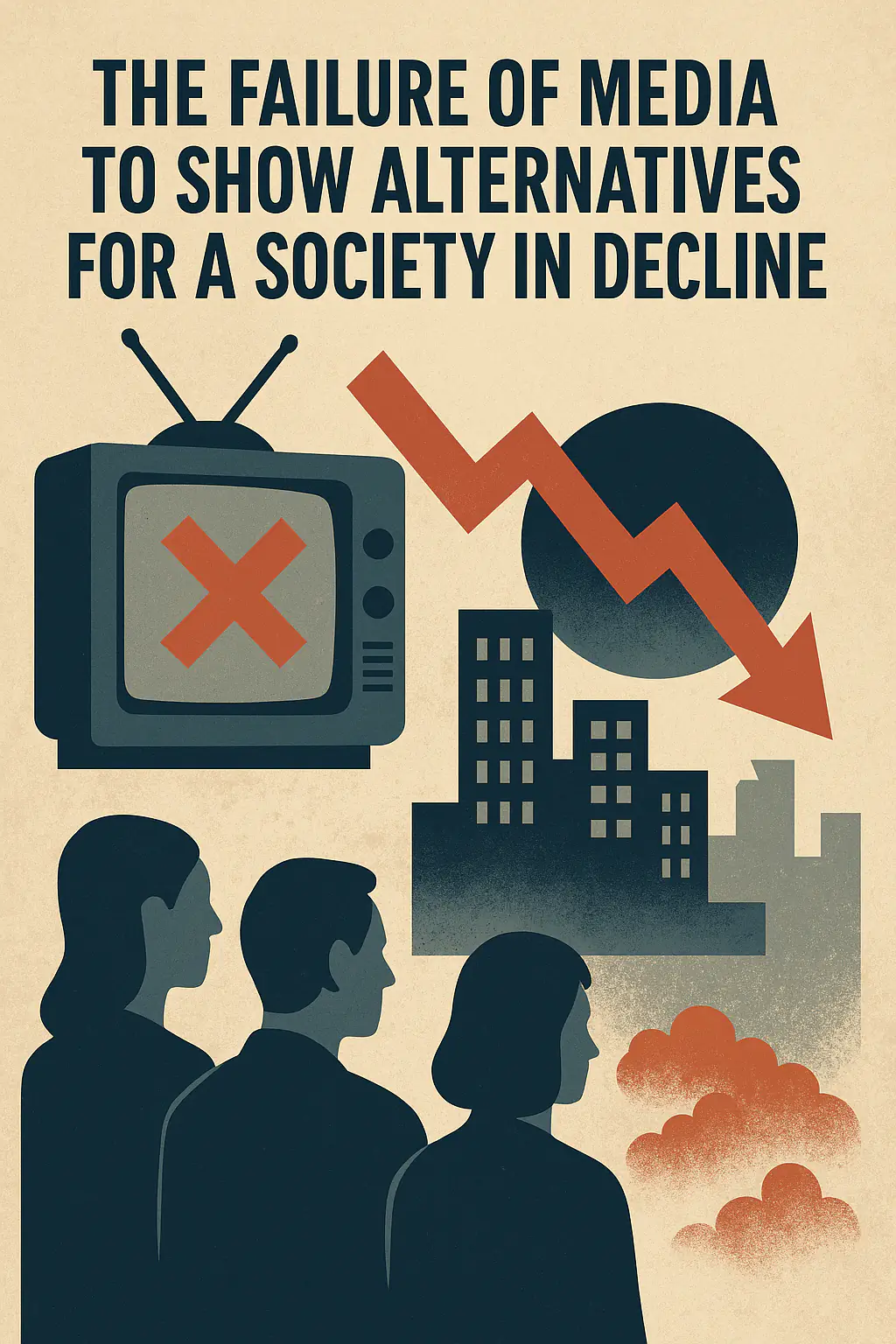
Modern society is saturated with information, yet strangely short on imagination. News cycles are crowded with stories of political conflict, economic anxiety, technological disruption, and social breakdown, but noticeably thin when it comes to clear, practical examples of alternative ways of organising work, ownership, and decision-making. The result is a public conversation that feels trapped: everyone can sense that many systems are under strain, yet the range of solutions presented rarely extends beyond minor adjustments to the status quo.
This is not because alternatives do not exist. Around the world there are long-running, large-scale models that organise economic life differently — worker-owned cooperatives, community-controlled enterprises, public banking systems, and shared ownership structures that operate successfully in competitive, high-tech environments. These models are not experimental, small, or symbolic. Some have been operating for decades, employ tens of thousands of people, and produce advanced industrial, technological, and financial services. Yet they remain largely absent from mainstream reporting and public debate.
One reason for this absence is structural. Much of the media ecosystem is funded by advertising, investment capital, and corporate ownership. Within that framework, stories that question the concentration of ownership and power are harder to frame, harder to monetise, and easier to sideline. Media does not need to suppress alternative models directly; it only needs to treat them as marginal, rare, or irrelevant. Over time, silence does the work that censorship once did.
Another factor is narrative simplicity. Mainstream media favours stories built around individuals — leaders, founders, villains, and heroes. Collective, democratic, long-term institutions do not fit easily into this mould. They have no single face, no dramatic rise-and-fall arc, and no clear moment of triumph or collapse. Their success is gradual and institutional rather than spectacular. In an attention economy driven by speed and emotion, this kind of story struggles to compete.
There is also an educational gap. Most people are taught to think about social organisation in a narrow set of terms: public versus private, state versus market. Models that blur or escape this binary are rarely explained, let alone normalised. Without a shared language for discussing ownership, governance, and institutional design, alternatives appear unfamiliar or unrealistic, even when they are already functioning in plain sight.
The consequence is a widespread sense of inevitability. When people are repeatedly shown only one way of organising society, that way begins to feel natural and unchangeable, regardless of its outcomes. Dissatisfaction grows, but imagination contracts. Problems are debated endlessly, while the range of “serious” solutions remains tightly constrained.
This is not a failure of curiosity on the part of the public. It is a failure of an information system that prioritises spectacle over substance and familiarity over usefulness. In a time of overlapping crises, the most responsible role of media would be to expand the horizon of what people know is possible. Instead, it often reinforces the quiet assumption that no credible alternatives exist.
Re-examining that assumption is not about ideology or nostalgia. It is about recognising that societies are designed systems, shaped by choices about ownership, power, and responsibility. When those choices are treated as invisible or inevitable, meaningful change becomes unthinkable. When they are made visible, new possibilities enter the conversation — and with them, the chance to build something that works better than what is failing now.
If mainstream media narrows what can be seen, then the responsibility to widen that view inevitably shifts outward. Real alternatives are more often found at the margins: independent publishers, cooperative media projects, long-form writing, community archives, and people willing to document what actually works rather than what merely dominates attention. Seeking out these sources is no longer a niche habit; it is a civic skill. Parallel Universe was written in that spirit — not as prediction or fantasy, but as a way of making institutional alternatives visible by placing them inside a human story. Fiction, at its best, can do what news cycles often will not: slow down, examine structure, and ask what kind of world could exist if different choices were made. In an age where information is abundant but imagination is constrained, looking beyond the mainstream is not escapism — it is a necessary step toward understanding how things might genuinely be made better.